Two years ago, “AI in software development” mostly meant autocomplete. Today an assistant can read a codebase, propose a refactor across several files, write the tests and explain what it did.
That is a genuine shift. It is also where many teams get into trouble — because generating code was never the hard part of building software. Understanding the problem, making good decisions and owning the result still are.
Here is how we think about it at LogicGigs, both in the software house and in the classroom.
What AI-assisted coding looks like day to day
Used well, an AI assistant is a tireless pair programmer. We use it to:
- Explain unfamiliar code — a legacy function, a library, a cryptic error.
- Generate tests — especially the edge cases humans forget.
- Refactor — extract a hook, split a component, rename things consistently.
- Scaffold — the boring first version of a form, a migration or an API route.
- Review — a second pair of eyes on a diff before a human reviewer sees it.
- Document — README sections, API notes, handover guides.
Each of these makes a good developer faster. None of them makes a developer unnecessary.
Vibe coding: the good, the risky
“Vibe coding” is describing what you want in plain language and letting the AI generate most of the code, steering by feel: make it faster, make it prettier, add a login.
It shines for:
- Prototypes and proof-of-concepts you plan to throw away.
- Internal tools and one-off scripts.
- Exploring an idea before committing a team to it.
It hurts when:
- The code handles money, personal data or security and nobody fully understands it.
- The prototype quietly becomes production.
- Edge cases, error handling and performance are never questioned.
- Nobody can maintain the result six months later.
Vibe coding is a fantastic way to start. It is a risky way to finish.
Our rules for AI in production code
- You own every line you merge. If you can't explain it, it doesn't ship.
- No secrets or client data in prompts. Ever.
- Tests before trust. AI-written code gets tested like any other code — usually more.
- Review AI diffs like a junior colleague's pull request: helpful, fast, occasionally confidently wrong.
- Architecture stays human. AI can suggest; people decide, with context the model doesn't have.
A realistic workflow
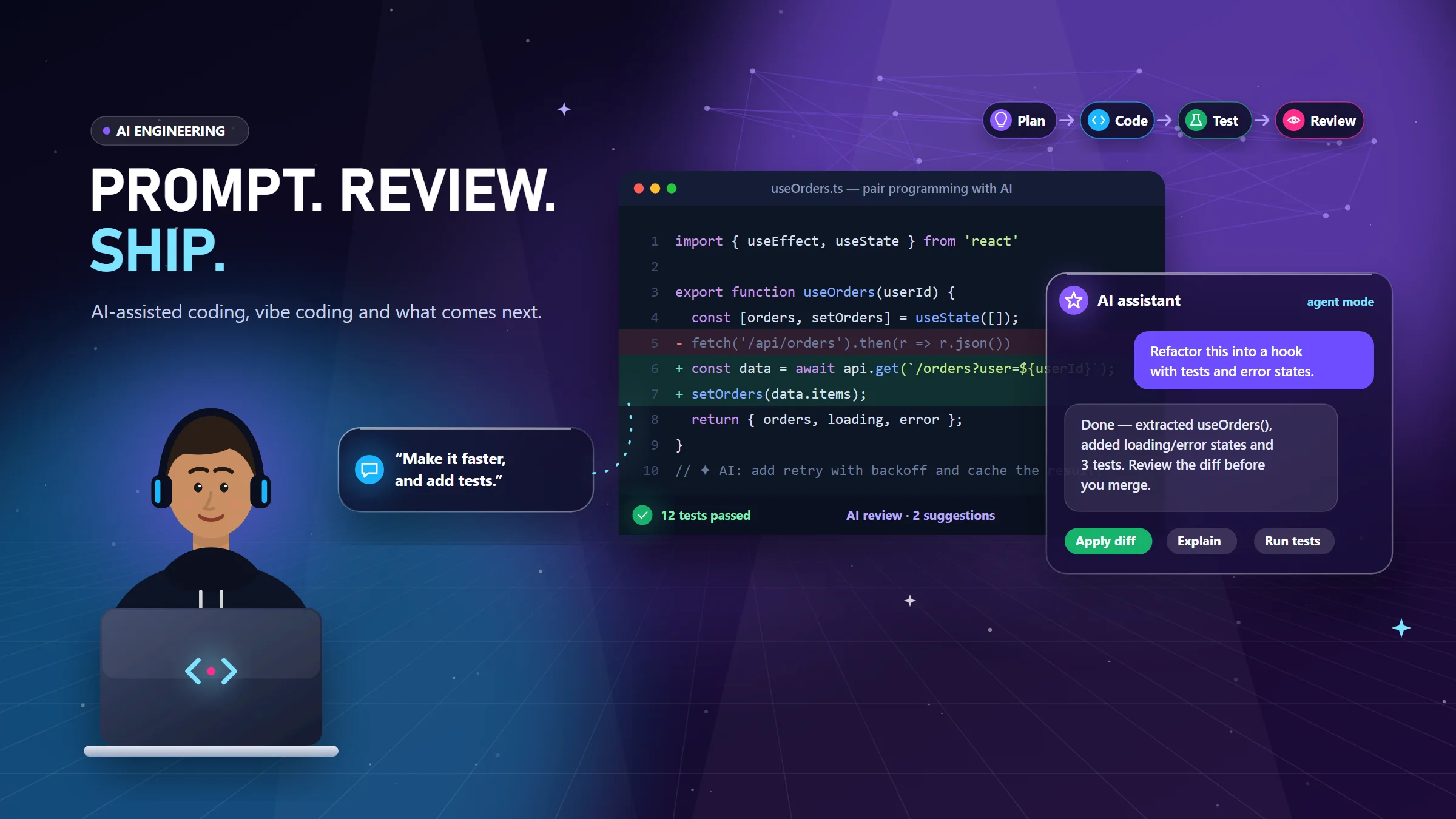
We teach and use a simple loop: Plan → Code → Test → Review.
“Refactor
OrderListso data loading lives in auseOrdershook. Keep the current props. Add loading and error states and write tests for empty, error and success cases.”
Notice what makes that prompt good: it names the file, the goal, the constraint (keep the current props) and the definition of done (tests for three cases). Then a human reads the diff, runs the tests and checks the behaviour in the browser before anything is merged.
From AI user to AI engineer
Using an assistant is one skill. Building AI into products is another — and it is becoming a core part of software engineering:
- Retrieval-augmented generation (RAG) — answering from your own documents, with sources.
- Evaluations — test sets that measure whether answers are correct, not just fluent.
- Guardrails — what the system must never say or do, and how you enforce it.
- Cost and latency — the unglamorous numbers that decide whether a feature survives.
The agentic direction
The next step is agentic AI: systems that plan multi-step tasks, call tools and APIs, keep memory and check their own work — triaging support tickets, preparing reports, updating records. Building them well is mostly software engineering: clear tool interfaces, permissions, logging, human approval for risky actions and relentless testing.
In other words, the developers best placed for the agentic future are the ones who understand APIs, data, security and product thinking — the fundamentals.
What this means for students
AI raises the floor and the ceiling at the same time. Beginners can build impressive things quickly. But the people who stand out are those who can read code, debug calmly, design systems and explain trade-offs — because that is exactly what AI cannot do on your behalf.
That is why our Code Academy includes a dedicated AI-assisted development module: using assistants responsibly, vibe coding for prototypes, reviewing and testing AI-generated code, and an introduction to AI engineering and agents.
Curious how we'd apply AI to your product — or want to learn it properly? See our AI & Automation service or the Full-Stack course.