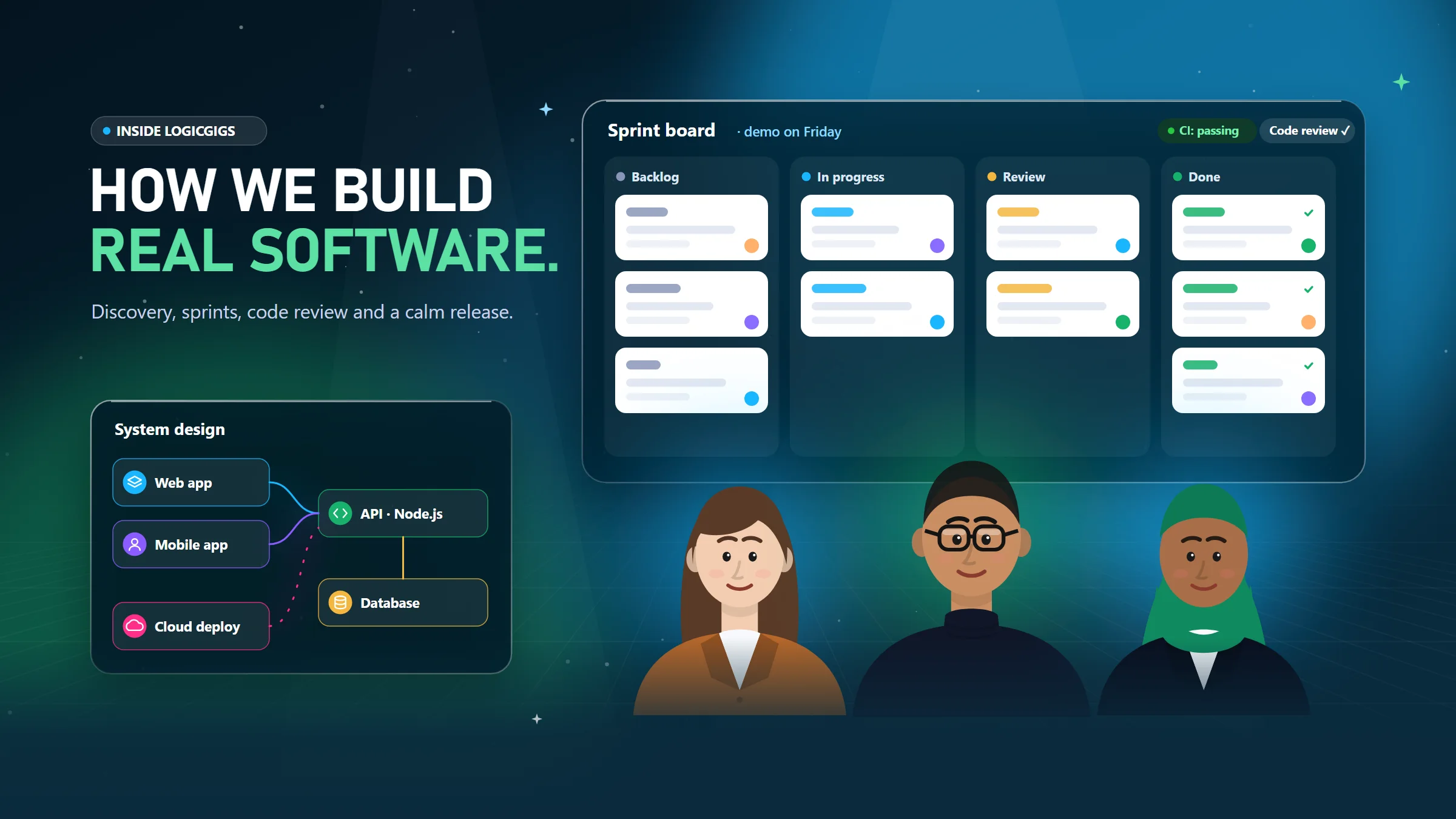
LogicGigs is a software house and code academy based in Nowshera. We build web platforms, business management systems, mobile apps and AI features — and we teach the same practices in our Code Academy.
People often ask what makes a software project succeed. After building systems for real shops and real teams, our answer is unglamorous: understand the work before you design the software, and take responsibility for it after launch.
This is how we do it.
We start with the workflow, not the screens
Before we open a design tool, we want to see how the work happens today — on paper, in a spreadsheet or in an old desktop program.
For a tailoring business, that meant following an order from the moment a customer walks in: measurements taken on a card, an order written in a register, a slip for the cutter, stitching, collection, the balance paid. For a tyre shop, it meant standing at the counter: a customer asks for a size, the shop checks stock, sells, fits the tyres and prints a receipt.
Once you see the real sequence, the software designs itself around it — not the other way round.
Scope you can hold us to
Every project starts with a written proposal: what is included, what is not, and what could come later. For Tyre Arena, for example, the agreed scope covered stock, sales, customers, purchases, service jobs, expenses and reports — while WhatsApp invoicing, a mobile app and online payments were explicitly listed as possible future add-ons.
Clear boundaries protect the budget, the timeline and the relationship.
Design that survives the shop floor
Business software is used in a hurry, by people who have customers waiting. So we design for that:
- Big, obvious actions — New order, New sale, Receive payment.
- Printing that works — bills and receipts on A4 and on 80 mm or 58 mm thermal printers.
- The shop's own language — including Urdu search, and measurement values kept exactly as the tailor writes them.
- Barcode scanners that work without drivers — scan to add an item, scan again to add one more.
Engineering standards we don't skip
Small businesses deserve the same care as large ones:
- Prepared statements everywhere, CSRF protection on every form, escaped output.
- Hashed passwords, login lockouts after repeated failures, and role-based access — owners see reports; staff do the daily work.
- Logs with reference codes instead of error messages that leak details.
- Automatic schema upgrades, so updates don't need manual database surgery.
We respect existing data
Replacing old software is only a success if nothing is lost. When the tailoring business moved from legacy MS Access software, every customer, measurement card and order was imported — including records found only in old backup files — while the original files were only ever read, never changed.
Launch calmly, then stay
Go-live is a rehearsal we've already done: printers tested, staff trained, data checked, a rollback plan ready. After launch we fix what real use reveals, and we plan the next improvements with the client.
See the work
- Tailor Management System (SaaS) — customers, measurements, orders, bills and online order tracking.
- Tyre Arena — shop management & POS — stock by size, barcode sales, thermal receipts and reports.
- Code Academy verification — QR-based certificate checks.
Have a workflow that deserves better software? Tell us about it — the first conversation is about your problem, not our technology.